PRICE ACTION
Retesting a breakout: acceptance, timing and the cost of waiting
After an important level has been reached, the price often returns to the area that was previously resisting or supporting. The retest is not mandatory, but when it appears, it gives the opportunity to verify whether the market has actually accepted new prices and whether the other party has lost control.
After an important level has been reached, the price often returns to the area that was previously resisting or supporting. The retest is not mandatory, but when it appears, it gives the opportunity to verify whether the market has actually accepted new prices and whether the other party has lost control. In market analysis, the most important is the repetitive method: first the context, then the evidence and at the end of the performance conditions. A single observation may draw attention to the market, but should not replace the full process.
What Is Really Worth Watching
A qualitative retest should respect the area struck, show less pressure against the original impulse and end with a reaction consistent with the direction of the outburst. Deep withdrawal, long maintenance on the wrong side of the level or increasing counter-aggression weaken the scenario. It is not about finding one number that settles the situation but about understanding the mechanism and conditions in which the information becomes useful.
How to Read It in Practice
Check the stroke zone before moving and do not move it after the event. When you retest, compare volume, delta, time spent at the level and closing of the candles. If the market quickly recovers direction at a reasonable spread, the setup is easier to define risk. It is worth saving the criteria before moving and after a time to check if they were actually met. Only then can you distinguish a useful signal from a story matched to the fact and improve the process based on data.
Most common error
The market can perform a full return to the range, and a seemingly retest can be the first signal of a failed breakout. The condition of the cancellation must be established earlier. Under greater volatility and time pressure, it becomes easier to mistake an interesting observation for a tested edge. Therefore, the condition for cancellation, the quality of the data and the cost of entry should be determined before the decision is made.
How HOSTuvo incorporates this context into the process
HOSTuvo can compile a retest with validation of breakout close, patch, flow and Execution GateGeometrically, the return to level alone is not enough — the system also checks the quality of the reaction and the real cost of entering the execution market. HOSTuvo does not submit automatic orders and does not guarantee the result. Research layers are settled after time, and the new model must be validated before it obtains the production impact.
Define the retest area and the allowed delay
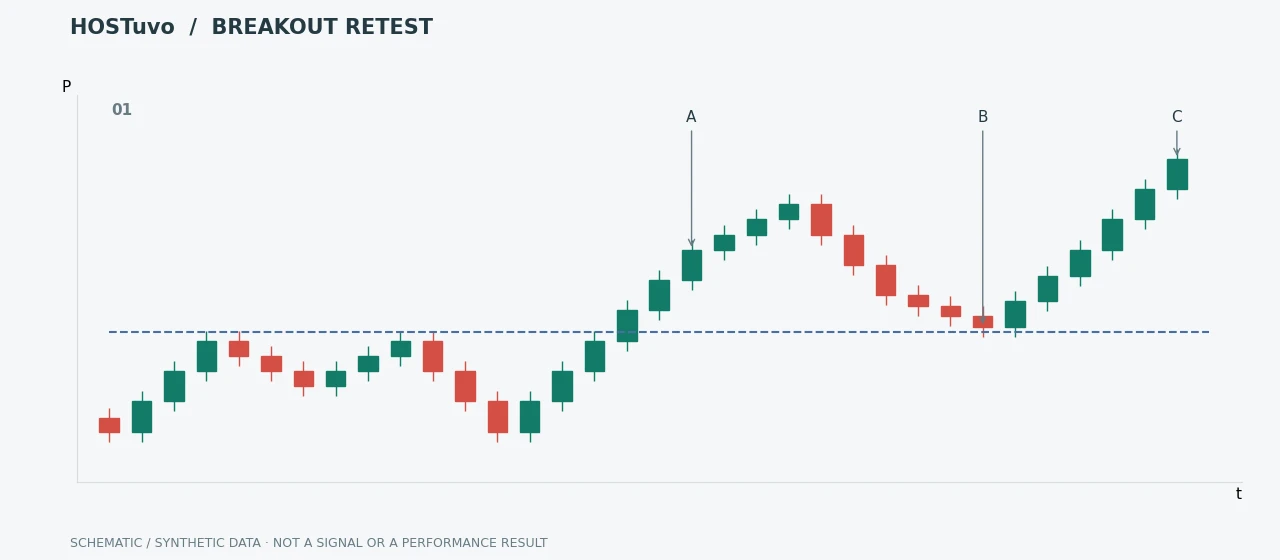
A retest is a return toward a previously crossed reference, but the acceptable distance and waiting period should be specified. Price need not touch an exact line to test the same area. Decide whether your rule requires a closed candle, a rejection sequence or another observable confirmation. A retest that occurs hours later in a changed market is not automatically equivalent to one immediately after the breakout. The purpose of waiting is to obtain different evidence, not to assume that a second visit removes risk.
Hypothetical breakout that does and does not return
Price closes above resistance at 60.00, reaches 60.80, then trades back near 60.10. If the area holds and a defined confirmation appears, the retest hypothesis can be assessed at that actual quote. On another path price moves directly to 62.00 without returning; a retest-based method has no entry. Counting the second path as a win because the direction was correct overstates that method's opportunity coverage. A realistic comparison records missed participation alongside any improvement in entry price or invalidation distance.
Do not rescue a failed retest by widening the zone
Keep the original boundary and failure condition visible. If price re-enters the old range and remains there, reassess the scenario rather than extending the retest zone to accommodate every decline. Compare the waiting method with immediate confirmation entry on the same candidate set, including costs and unfilled orders. A retest may improve selectivity while reducing the number of available trades. Neither effect is automatically better: the relevant question is whether the complete forward record supports the trade-off for the intended horizon.
Example chart pattern
Sources and example scope
The references explain the underlying definitions and mechanisms. Numerical scenarios are hypothetical teaching examples, not forecasts or reported HOSTuvo returns.
IN HOSTuvo
See this context in the live terminal.
HOSTuvo can compile a retest with validation of breakout close, patch, flow and Execution GateGeometrically, the return to level alone is not enough — the system also checks the quality of the reaction and the real cost of entering the execution market.